
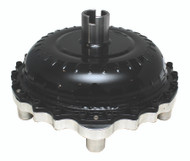
The Hidden Heavyweight: Why a Torque Converter Can Make—or Break—Your Performance Build
7th May 2026
The Hidden Heavyweight: Why a Torque Converter Can Make—or Break—Your Performance Build
In the world of high-performance automatics, horsepower gets the headlines and transmissions get the credit. But tucked between the engine and the gearbox is a component that quietly determines how all that power actually reaches the pavement: the torque converter.
Often misunderstood as “just an automatic clutch,” the torque converter is far more influential—and far more sensitive—than most enthusiasts realize. Install it incorrectly, and even the best-built drivetrain can suffer catastrophic failure. Install it correctly, and it becomes a precision tool that transforms throttle input into controlled, repeatable acceleration.
More Than a Bolt-On Part
A torque converter lives in one of the most hostile environments in a car: spinning at engine speed, absorbing shock loads every time you leave the line. In racing applications, it’s responsible for how hard the car launches, how quickly it reaches its powerband, and how efficiently it transfers torque at speed.
Unlike many aftermarket parts, torque converters aren’t universal. Vehicle weight, engine combination, transmission type, and intended use all influence their design. And because every chassis and drivetrain layout is slightly different, installation requires careful verification at every step.
That’s why performance manufacturers like FTI Performance treat torque converter installation not as a suggestion, but as a discipline.
Setting the Stage: Prep Is Protection
Before a transmission ever comes out, safety and cleanliness matter. A level work surface, solid jackstand support, and a fully disconnected battery prevent accidents that can turn a simple install into a dangerous one.
Once the transmission is safely supported and fluid drained, removal begins: driveshaft, starter, cooler lines, shifter linkages, wiring harnesses. It’s not glamorous work, but it’s essential. Automatics are heavy, awkward, and unforgiving if rushed.
With the transmission out, there’s a rare opportunity many overlook: inspection.
The Flexplate Check Most People Skip
The flexplate is the mechanical handshake between the engine and the converter. Cracks, chipped teeth, or fatigue around the mounting pads can spell disaster once power is applied. Replacing a questionable flexplate while everything is accessible is cheap insurance compared to repairing an engine or transmission later.
Only after this inspection does the new converter enter the picture.
Fitment Before Installation—Not After
One of the most critical steps happens outside the transmission. Before fluid is added or parts are bolted together, the converter should be test-fitted against the engine and flexplate. The goal is simple but non-negotiable: the converter pads must sit flat against the flexplate, and the pilot must engage the crankshaft by at least ⅛ inch.
This step confirms compatibility before mistakes become expensive.
Once confirmed, a quart of fresh transmission fluid is added directly to the converter—a step that protects internal components on first startup.
The “Three Clicks” That Matter
Installing the converter into the transmission isn’t about force—it’s about feel. As the converter slides onto the input shaft, stator support, and pump gear, it should seat in stages. Most manufacturers describe this as three distinct engagements.
Miss one, and the converter won’t be fully seated. Start the engine like that, and the transmission pump can be destroyed instantly.
To remove any guesswork, professionals rely on measurements. The distance from the bellhousing face to the converter pads varies by transmission, but being within tolerance is critical.
Alignment Is Everything
When the transmission goes back in, patience becomes critical. The bellhousing must sit perfectly flush against the engine block before bolts are tightened. Using bolts to pull the transmission into place is a guaranteed way to damage components—and it’s the kind of mistake warranties don’t cover.
Once secured, a simple but vital check follows: the converter should spin freely by hand.
Final Spacing: The Last Margin for Error
Even after everything is bolted up, converter-to-flexplate spacing must be verified. Ideally, there should be between ⅛ and 3/16 inch of clearance before the converter is pulled forward and bolted down.
Precision Pays Off
Modern performance torque converters don’t require break-in periods. When installed correctly, they’re ready to perform immediately—launch after launch, pass after pass.
The takeaway is simple: torque converters aren’t forgiving parts. They reward careful installation and punish shortcuts. Whether you’re building a bracket car, a street/strip machine, or a serious race vehicle, understanding what’s happening inside the bellhousing can be the difference between reliable performance and an expensive teardown.